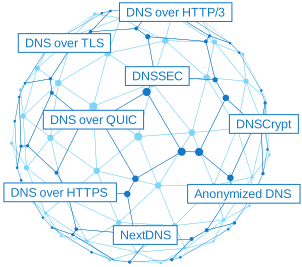
YogaDNS automatically intercepts DNS requests at the system level and allows you to process them over user-defined DNS servers using modern protocols and flexible rules.
The keyword HCiSO primarily refers to a well-known software cracking and release group specializing in high-end creative and professional software for macOS and Windows. In the digital world, "HCiSO" is frequently associated with the distribution of expensive plugins, digital audio workstations (DAWs), and visual effects tools. Below is an overview of the context and impact of this keyword within the software industry. The Role of HCiSO in Software Distribution The name HCiSO is most commonly seen in the titles of software releases found on specialized forums and community-driven sites like VSTclub . The group focuses on bypassing the copy protection (often referred to as "cracking") of professional-grade software. Software Specialization : HCiSO is renowned for releasing content related to audio production (VST plugins, synthesizers) and video editing. Platform Focus : While many groups target Windows, HCiSO is particularly noted for its macOS-compatible releases, often including "U2B" (Universal 2 Binary) versions that run natively on Apple Silicon (M1/M2/M3 chips). Release Tagging : The tag [HCiSO] at the end of a file name serves as a "signature" for the group, indicating the origin of the bypass method used. Common HCiSO-Related Software If you are searching for HCiSO, you are likely looking for tools from manufacturers such as: Tegeler Audio Manufaktur : High-end analog-modeled audio effects. Pulsar Modular : Specialized audio mixing and mastering plugins. FabFilter & Waves : Essential suites for music production that are frequently updated by release groups. Technical and Legal Context From a technical standpoint, groups like HCiSO often reverse-engineer software to remove license checks or hardware dongle requirements. Description Activity Reverse engineering and digital rights management (DRM) removal. Risk Downloading files from unofficial sources carries significant risks of malware, ransomware, or system instability . Legality Using software distributed by HCiSO is a violation of copyright law and the End User License Agreement (EULA) of the original developers. Why Support the Developers? While HCiSO provides "free" access to expensive tools, the software industry relies on sales to fund innovation. Many professional developers offer: Rent-to-Own Programs : Making expensive plugins affordable through monthly payments. Educational Discounts : Significant price drops for students and teachers. Trial Versions : Most high-end plugins offer a 14 to 30-day trial so you can test the software before committing to a purchase.
Adobe Creative Cloud apps, and various music plugins. Facebook If you are looking to use their releases, here is a guide on how to safely navigate the process. 1. Finding Reliable Sources Since HCiSO does not have an official website, their releases are distributed through various third-party trackers and community forums. Reputable Trackers
The Hardware-Enforced Cryptographic Isolation of Secure Objects (HCISO): A Paradigm Shift in System Security Introduction For decades, the foundational model of operating system security has rested upon a privileged kernel mediating all access to hardware resources. This monolithic model, while flexible, has proven increasingly fragile. The discovery of transient execution attacks (Spectre, Meltdown), kernel data pointer corruption, and the sheer size of the trusted computing base (TCB) have demonstrated that software isolation alone is insufficient. In response, a new architectural paradigm has emerged: Hardware-enforced Cryptographic Isolation of Secure Objects (HCISO) . Unlike traditional memory protection units (MPUs) or memory management units (MMUs) that rely on address-based rules, HCISO treats sensitive data and code as cryptographically sealed objects. Access is granted not by possessing a valid virtual address, but by possessing a valid, unforgeable cryptographic capability. This essay explores the principles, mechanisms, advantages, and challenges of HCISO, arguing that it represents a fundamental advance toward verifiably secure computing. The Limitations of Software and Address-Based Isolation Traditional isolation relies on an MMU to translate virtual addresses to physical addresses, checking permission bits (read, write, execute) along the way. The operating system kernel acts as the reference monitor, managing page tables. This model suffers from several intractable problems:
Large TCB: The entire kernel, including thousands of device drivers, must be trusted. A single bug in any privileged component can bypass all isolation. Side-channel vulnerability: MMU-based isolation does nothing to prevent timing or cache-based side channels (e.g., Prime+Probe), as co-resident processes share microarchitectural resources. Transient execution: Speculative and out-of-order execution can leak data across privilege boundaries before permission checks are finalized. Pointer forgery: If an attacker can corrupt a kernel pointer, they can redirect access to any physical memory location. The keyword HCiSO primarily refers to a well-known
HCISO directly addresses these issues by removing the kernel as the arbiter of all memory access and by making access tokens cryptographic, rather than positional. Core Principles of HCISO HCISO is built on three interrelated principles:
Cryptographic capabilities, not addresses: Every secure object (a memory region, a peripheral state, or a code block) is associated with a unique, high-entropy cryptographic key. Access requires presenting a capability token that embeds this key, cryptographically signed or MAC-ed by a hardware root of trust. Hardware-enforced sealing: A dedicated hardware unit—the Cryptographic Isolation Unit (CIU)—sits between the CPU cores and the memory hierarchy. It encrypts and integrity-protects each secure object with its unique key. Data is stored encrypted in main memory and decrypted only inside the CPU's secure enclave registers. Explicit object-based access: There is no notion of "every byte in a virtual address space." Instead, a process or enclave holds a set of capability references. To read or write a secure object, the CPU core issues a request with the capability. The CIU verifies the capability's authenticity, fetches the ciphertext, decrypts it, and returns plaintext—all without kernel involvement.
Mechanism in Practice A typical HCISO-enabled processor operates as follows: The Role of HCiSO in Software Distribution The
Object creation: A secure monitor (a tiny, formally verified firmware) invokes a hardware instruction CREATE_OBJECT . The CIU generates a random key $K_{obj}$ and a capability $C_{obj} = MAC(K_{root}, \text{object ID} \parallel K_{obj})$. The object's initial data is encrypted with $K_{obj}$ and stored. The caller receives $C_{obj}$. Access: To read, the core executes LOAD $C_{obj}, offset . The CIU verifies the MAC on $C_{obj}$, derives $K_{obj}$, fetches the ciphertext block, decrypts it, and returns plaintext. Write is symmetric: encrypt then store. Delegation: A process can send $C_{obj}$ to another process via a secure channel (e.g., using a shared session key). The recipient can now access the object directly, even if the sender exits or the kernel is compromised. No page table update is needed. Revocation: Revocation is achieved by re-encrypting the object with a new key and issuing new capabilities. Old capabilities become invalid because they cannot decrypt the new ciphertext.
Comparison with Existing Technologies HCISO is often confused with other hardware security features, but key differences exist: | Feature | Traditional MMU | Intel SGX (Software Guard Extensions) | CHERI (Capability Hardware Enhanced RISC Instructions) | HCISO | | :--- | :--- | :--- | :--- | :--- | | Isolation basis | Address ranges | Encryption + software checks | Fat pointers (address + bounds + permissions) | Cryptographic keys per object | | Kernel trust | Full trust | Minimal (but side channels remain) | Moderate (MMU still present) | Zero trust for confidentiality | | Side-channel resistance | None | Weak (cache timing) | None | High (encryption+access pattern hiding) | | Object granularity | Page (4KB) | Page (4KB) | Byte/word | Arbitrary (down to bytes) | | Revocation | Page table update | Re-sealing | Bounds check | Re-encryption | HCISO's unique strength is that even if an attacker controls the entire OS and can read all physical memory, they cannot access a sealed object without its capability. The ciphertext remains computationally indistinguishable from random noise. Security Advantages
Kernel independence: A compromised kernel can deny service (e.g., refuse to schedule a process) but cannot read or modify HCISO-protected objects. The kernel cannot forge a capability because it lacks the hardware root key. Mitigation of transient execution: Since data is decrypted only inside the CPU pipeline after access checks, speculative execution that attempts to access an object without a capability will receive only encrypted noise. Leakage is prevented. Fine-grained, revocable delegation: A server can hand a client a capability with a limited lifetime (e.g., embedded expiry timestamp) without trusting a central authority. Natural compartmentalization: Complex applications can be split into isolated objects (e.g., a TLS private key object, a database row object). A vulnerability in one object does not compromise others. Platform Focus : While many groups target Windows,
Performance and Practical Challenges Despite its promise, HCISO faces significant hurdles:
Encryption overhead: Every memory access to a secure object requires decryption on load and encryption on store. While modern AES instructions (AES-NI) help, latency increases by roughly 5–15% in current prototypes. Capability management: Storing, passing, and revoking many small capabilities (potentially billions in a cloud server) requires efficient garbage collection and key management hardware. Object granularity vs. fragmentation: Very small objects (e.g., a single integer) incur high overhead due to per-object metadata and encryption padding. Lack of software ecosystem: Existing operating systems, compilers, and libraries assume a flat virtual address space. Porting to HCISO requires rewriting memory allocators, IPC mechanisms, and I/O subsystems. Key storage scalability: The CIU must securely store or derive thousands of object keys. Hierarchical key derivation (e.g., key tree based on capability paths) is an active research area.